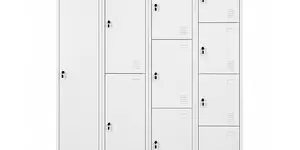

Every time an employee slides open a file drawer or adjusts a steel shelf, they interact with a product that has travelled through a remarkably sophisticated manufacturing journey. Yet few people ever consider what happens inside a modern factory to turn a heavy coil of cold‑rolled steel into a precision‑engineered cabinet that will withstand decades of daily use. Understanding this production process not only reveals why quality furniture costs what it does, but also helps facility managers and procurement professionals make smarter, more durable choices for their workplaces.
Steel Office Furniture Production Process
This article takes you step by step through a typical steel office furniture production line—from raw material receiving to final packaging—highlighting the critical operations, equipment, and quality benchmarks that separate premium products from budget alternatives.
1.Raw Material Receiving and Inspection
The journey begins with the arrival of cold‑rolled steel coils or sheets. Most reputable manufacturers source steel from major mills such as Baosteel or Wuhan Steel in China, or equivalent international suppliers. Upon delivery, the material undergoes a rigorous incoming inspection:
Thickness verification – using digital micrometers to ensure the steel matches the specified gauge. For standard office filing cabinets, body panels typically range from 0.5 mm to 1.0 mm, with heavy‑duty frames often using 0.8 mm or 1.0 mm steel.
Surface quality check – inspectors look for rust, scratches, or oil contamination that could affect later forming and coating.
Mechanical property testing – tensile strength and yield point are sampled to confirm they meet the required standards (e.g., Q195 or Q235 grade steel).
Only after passing these checks does the steel enter the production floor.
2.Cutting and Blanking – Precision First
The first physical transformation is cutting the large coils or sheets into individual component blanks. Modern factories rely on two main technologies:
CNC laser cutting machines – these provide exceptional accuracy (tolerances within ±0.1 mm) and produce clean, burr‑free edges. They are ideal for complex shapes and small batch runs.
CNC hydraulic shearing machines – used for high‑volume straight cuts, these shears can process sheets up to 4 metres long in a single stroke.
During this stage, the steel is divided into pieces that will become side panels, doors, drawer fronts, backs, shelves, and reinforcement brackets. Each part is precisely dimensioned according to the CAD blueprints developed during the design phase.
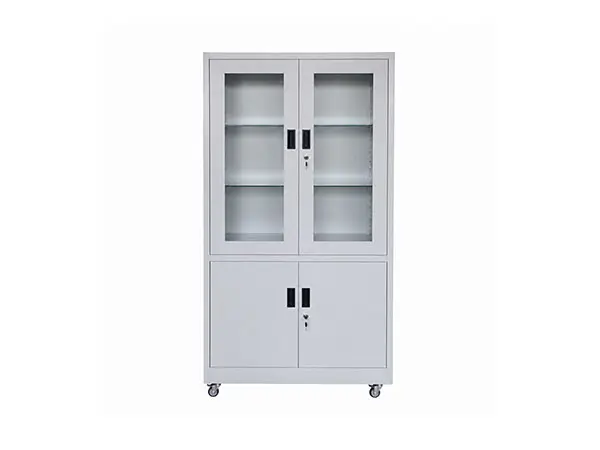
3.Stamping and Punching – Creating the Details
With the blanks cut, the next operation is stamping and punching. Using CNC turret punch presses or progressive dies, the factory creates all the necessary holes and slots:Mounting holes for hinges, handles, and locks.Ventilation louvres (often in a standard pattern).Drawer slide attachment points.Cable management openings (for computer furniture).
High‑end factories use servo‑driven punch presses that can perform up to 600 strokes per minute, ensuring consistent hole placement across thousands of parts. The use of precision tooling guarantees that every hole aligns perfectly during assembly, preventing misaligned doors or sticky drawers.
4.Bending and Forming – Shaping the Steel
Now the flat blanks move to the bending department, where they are transformed into three‑dimensional components. CNC press brakes with back‑gauge systems are the workhorses here. They apply precise angles – typically 90° for cabinet corners, but also complex folds for drawer bodies and shelf edges.
A typical bending sequence for a cabinet side panel might involve five or six separate bends. The key parameters are:
Bend allowance – calculated to avoid cracking or wrinkling
Angle accuracy – held to ±0.5° to ensure squareness
Spring‑back compensation – the press brake over‑bends slightly to account for the steel’s natural elasticity
For high‑volume production, some factories use panel benders that can perform multiple bends in one automated cycle, dramatically increasing throughput while maintaining consistency.
5.Welding – Joining the Structure
With all parts formed, the cabinet body must be permanently assembled. Welding is the primary joining method, and the choice of technique affects both strength and appearance:
Spot welding (resistance welding) – used for overlapping joints, such as attaching internal brackets or stiffeners. A typical spot weld lasts only 0.2–0.5 seconds and creates a strong nugget without adding filler material.
CO₂ gas‑shielded arc welding (MIG/MAG) – employed for heavy structural joints, like the main frame corners. This provides deep penetration and high load‑bearing capacity.
Laser welding – increasingly used for high‑end products, offering very narrow heat‑affected zones and virtually invisible seams.
To maintain straightness and squareness, components are clamped into welding jigs before welding. After welding, the assemblies go through a grinding and polishing station to smooth weld beads, remove splatter, and create a uniform surface ready for finishing.
6.Surface Preparation – The Critical Pre‑Treatment
Before any coating can be applied, the steel must be meticulously cleaned and chemically prepared. This multi‑stage process – often called the pre‑treatment line – is arguably the most vital step for long‑term corrosion resistance.
A typical automated line includes:
Alkaline degreasing (50–60°C) – removes rolling oils, cutting fluids, and handling grease.
Hot water rinse – washes away degreasing agents.
Acid pickling (using diluted hydrochloric or sulphuric acid) – removes mill scale and light rust.
Cold water rinse – neutralises acid residues.
Surface conditioning – applies a fine grain activator to promote phosphate crystal growth.
Zinc phosphating (40–50°C for 3–5 minutes) – creates a micro‑crystalline phosphate layer (typically 2–5 g/m²) that provides excellent mechanical keying for the powder coat and adds corrosion protection.
Deionised water rinse – eliminates any remaining ions that could cause blistering.
Hot air drying – ensures the components are completely moisture‑free before coating.
Some modern lines have replaced phosphating with ceramic conversion coatings (such as zirconium‑based), which are more environmentally friendly and still provide good adhesion. Both methods are validated by salt spray tests (ASTM B117), with premium products achieving 500–1,000 hours of rust resistance.
7.Electrostatic Powder Coating – The Durable Finish
With the surface fully prepared, the components enter the powder coating booth. Here, a dry paint powder – typically a polyester‑epoxy hybrid – is electrostatically charged and sprayed onto the grounded steel parts. The electrostatic attraction ensures even coverage, even on corners and recessed areas.
Key parameters at this stage:
Powder particle size – usually 20–50 microns
Spray voltage – 60–90 kV
Compressed air pressure – 0.4–0.6 MPa
After spraying, the coated parts move into a curing oven. The oven temperature profile is crucial:
Typically 180°C to 200°C for 10 to 15 minutes (dwell time at peak temperature).
The powder melts, flows, and chemically cross‑links to form a continuous, hard film.
The final dry film thickness is measured with a non‑destructive coating thickness gauge. Industry standards (e.g., GB/T 3325‑2017) require a minimum of 50 microns (µm) ; most quality manufacturers aim for 60–80 µm to ensure superior scratch and corrosion resistance.
8.Assembly and Hardware Installation
Once cooled, the painted components move to a clean assembly area, where workers (or robotic cells) install all functional hardware:
Drawer slides – heavy‑duty ball‑bearing slides, typically rated for 40‑kg to 60‑kg load per drawer.
Locks and locking bars – central locking systems that secure all drawers with a single key turn.
Handles and pulls – attached with tamper‑proof screws.
Hinges – for doors, often with adjustable height and depth settings.
Label holders and bumpers – for added convenience and protection.
Every assembled unit is checked for drawer smoothness, door alignment, and lock engagement. Drawers are fully extended and loaded with test weights to verify that the slides operate without binding.
9.Final Quality Control – Leaving No Defect Behind
Before packaging, each cabinet undergoes a comprehensive final inspection that covers:
Dimensional accuracy – verifying overall height, width, and depth against the blueprint.
Surface finish – visual inspection for pinholes, orange peel, or scratches under standard lighting.
Adhesion test – a cross‑hatch tape test to ensure the powder coating bonds securely (classified as Grade 1 or better per ISO 2409).
Load testing – drawers are subjected to their rated capacity (e.g., 40 kg) and cycled 20–30 times to assess durability.
Corrosion check – spot testing with a copper sulphate solution to confirm phosphating quality.
Units that fail any test are sent for rework or scrapped. This stringent gatekeeping ensures that only products meeting the highest standards reach the customer.
10.Packaging and Dispatch – Protecting the Investment
The final stage is careful packaging. Each cabinet is wrapped in anti‑scratch film, fitted with edge protectors, and boxed in heavy‑duty corrugated cartons. For export, many manufacturers use knock‑down (KD) flat‑pack designs to reduce shipping volume (CBM) and freight costs. The packages are then palletised, strapped, and labelled ready for shipment.
The Takeaway – Why Process Matters
Understanding this elaborate production sequence reveals why a well‑made steel cabinet costs more than a flimsy alternative. The extra investment in thicker steel (0.8 mm vs. 0.5 mm), a full phosphating line, and a 60‑µm powder coat translates directly into a product that can last 15–25 years in a busy office. Cutting corners in any of these steps leads to premature rust, sticking drawers, and early replacement.
Next time you open a smooth‑gliding steel drawer, you can appreciate the precision cutting, the carefully controlled welding, the chemistry of the pre‑treatment, and the electrostatic magic of the powder coating – all working together to deliver reliable, everyday performance. That is the true value of quality manufacturing.